HÉLAS
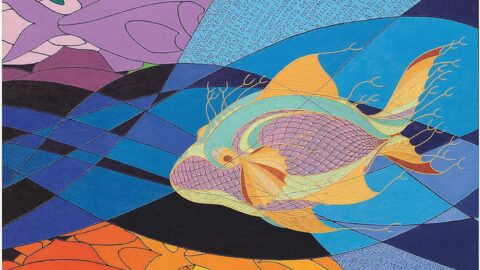
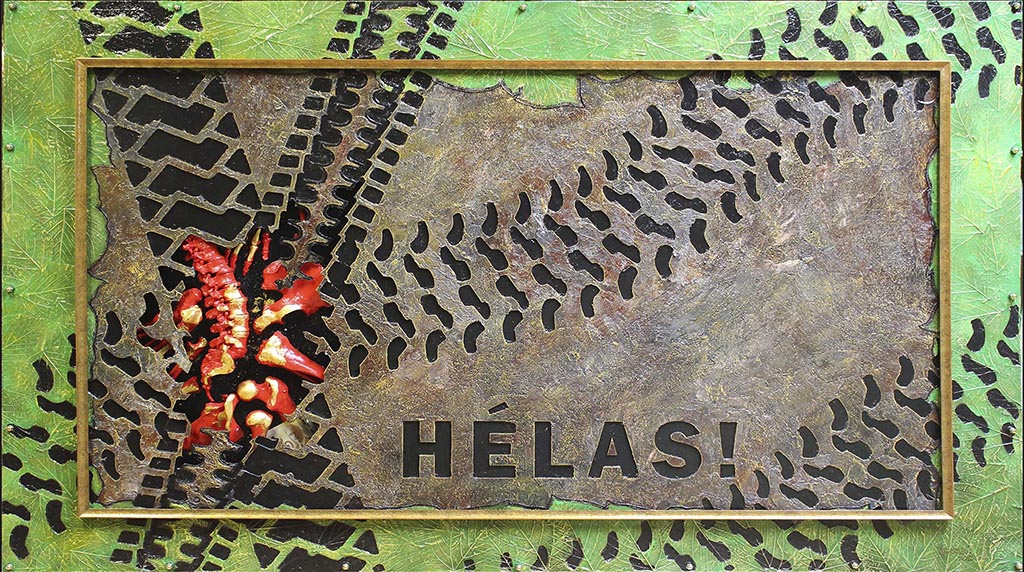
Mix médias, Acrylique et feuilles d’or, caisson de bois sous-relief 122 x 183 cm
English text follows below
Né en 1950, au cœur du XXe siècle, j’ai grandi dans l’espoir d’une ère de progrès radieux après l’innommable désastre de la guerre de 1939-1945. Hélas, les technologies guerrières – qu’elles soient mécaniques, chimiques, organisationnelles ou idéologiques – se sont banalisées, et ma génération a assisté, impuissante, à la rapide dégradation du monde, notamment du milieu naturel, traité comme un ennemi à dompter.
Au début des années 1970, la lecture du rapport du Club de Rome et de Small is Beautiful de Schumacher a éveillé en moi une prise de conscience aiguë du désastre environnemental, un fléau qui s’amplifie encore aujourd’hui.
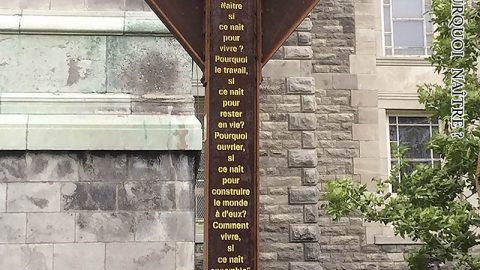
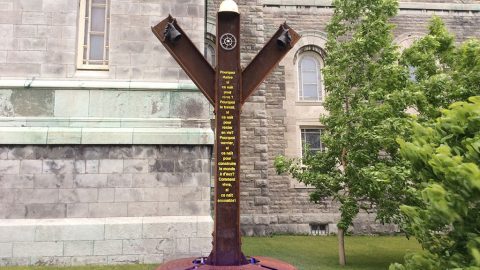
En 2015, invité par Pierre Larivière, agent culturel à la Maison de la Culture Maisonneuve, j’ai exposé l’œuvre monumentale Pourquoi Naître ?. Pour honorer sa générosité et remplir l’espace alloué, j’ai créé trois nouvelles œuvres, nées de l’inquiétude environnementale croissante qui m’habite depuis des décennies.
Parmi elles, deux tableaux de 122 x 183 cm forment un diptyque, complété par une troisième œuvre intitulée 24/7.
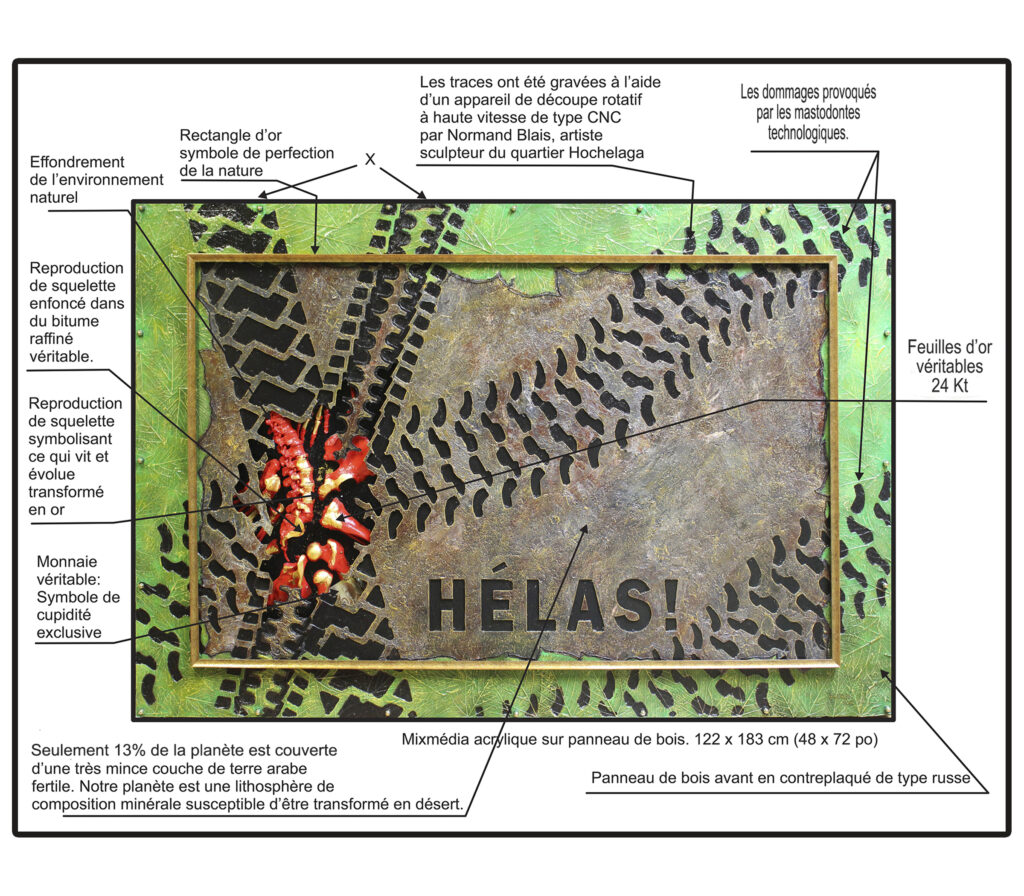
La première, Hélas, partie intégrante de ce diptyque avec Probio, est une création mixte au style « Steampunk », méditant sur les dérives technologiques. Réalisée sur un caisson en contreplaqué de merisier – à la fois tableau et sous-relief –, elle présente une échancrure profonde. Sa surface est ornée de véritables feuilles de tilleul, collées et peintes en divers verts, symbolisant la nature et ses dimensions artistiques et culturelles idéales, issues d’un bois prisé par les sculpteurs.
Un cadre doré, respectant le format du rectangle d’or, encadre cette composition, soulignant la désertification causée par la brutalité d’une technologie vorace.
Cette dernière éventre l’environnement, ignorant son antique vitalité, pour le recouvrir d’un or froid et stérile le temps d’un instant.
À l’intérieur de l’échancrure, des reproductions d’os humains, agglutinées à du pétrole figé en goudron, sont peintes en rouge sang. Partiellement recouvertes de feuille d’or véritable, elles s’accompagnent d’un billet de 100 $, à la fois authentique et symbolique, intégré au goudron.

Born in 1950, at the heart of the 20th century, I grew up with the hope of an era of radiant progress following the unspeakable disaster of the 1939-1945 war. Alas, war technologies—whether mechanical, chemical, organizational, or ideological—have become commonplace, and my generation has watched, powerless, as the world, especially the natural environment, rapidly deteriorated, treated as an enemy to be tamed.
In the early 1970s, reading the Club of Rome’s report and Schumacher’s Small is Beautiful awakened in me a sharp awareness of the environmental disaster, a scourge that continues to worsen today.
In 2015, invited by Pierre Larivière, cultural agent at the Maison de la Culture Maisonneuve, I exhibited the monumental work Why Be Born?. To honor his generosity and fill the allocated space, I created three new works, born from the growing environmental concern that has inhabited me for decades.
Among them, two 122 x 183 cm paintings form a diptych, completed by a third work titled 24/7.
The first, Hélas! “Alas”, an integral part of this diptych with Probio, is a mixed-media creation in a “Steampunk” style, reflecting on the excesses of technology.
Crafted on a cherry plywood case—both a painting and a bas-relief—it features a deep recess. Its surface is adorned with real linden leaves, glued and painted in various greens, symbolizing nature and its artistic and cultural ideals, derived from a wood prized by sculptors.
A golden frame, adhering to the golden rectangle format, encases this composition, highlighting the desertification caused by the brutality of a voracious technology.
This force tears into the environment, disregarding its ancient vitality, only to cloak it in cold, sterile gold for a fleeting moment.
Within the recess, reproductions of human bones, agglutinated with petroleum solidified into tar, are painted blood-red.
Partially covered with real gold leaf, they are accompanied by a $100 bill, both authentic and symbolic, embedded in the tar.