Le Harfang, le tronc et l’horizon d’un monde en mutation
C’était en 1962, une année gravée dans ma mémoire comme un moment fondateur. J’avais 12 ans, et cette année-là, un enseignant passionné venu de France, Robert Féger, nous initiait aux merveilles des civilisations antiques. Archéologue amateur à ses heures, il savait transmettre avec une ferveur contagieuse l’importance des traces laissées par l’humanité à travers les âges. Parmi ces civilisations, celle de l’Égypte ancienne se distinguait par la grandeur et la profondeur de ses œuvres. Ces créations, issues des profondeurs du temps, projetaient leur ombre majestueuse sur notre époque contemporaine, comme un écho venu d’un autre monde
Je me souviens encore avec une précision quasi tactile de la sculpture en pierre représentant Horus, le dieu faucon, stylisé et intemporel. L’élégance des lignes, la symbolique puissante, la précision du détail : tout dans cette œuvre m’avait bouleversé. Pour le jeune garçon que j’étais alors, c’était une révélation.
Quelques années plus tôt, en février 1959, j’avais fêté mes neuf ans, une étape marquée par une promesse que je m’étais faite à moi-même. Au milieu d’un été illuminé d’un soleil éclatant, j’avais pris une décision intérieure, presque instinctive : je deviendrais artiste. Je savais déjà que je voulais construire une vie à l’opposé de l’enfance misérable que je vivais alors. À 12 ans, cette volonté s’est traduite dans mes premières créations, en sculptant avec un canif de simples morceaux de bois tendre, inspirés des images d’ouvrages d’archéologie que je feuilletais avec fascination.
Presque trente ans plus tard, cette impulsion s’était transformée en une passion pour la sculpture en bronze. L’art aviaire était devenu un thème récurrent dans mon travail, un univers qui, comme l’art égyptien, portait une charge symbolique forte et intemporelle.
C’est dans cette quête que j’ai trouvé mon propre « Horus », une figure personnelle qui ferait écho à celle qui m’avait tant marqué enfant. À l’époque, mon agent, Normand Prescott, avait emprunté pour moi un Harfang des neiges empaillé à l’Université du Québec à Trois-Rivières. Pendant un mois, cet oiseau majestueux a régné dans mon atelier, immobile et silencieux, comme une muse venue du froid. Je l’ai transformé en une sculpture grandeur nature, façonnée en cire et coulée en bronze grâce au procédé de la cire perdue, à la fonderie Artcast située à Georgetown près de Toronto en l’absence de l’équivalent au Québec.
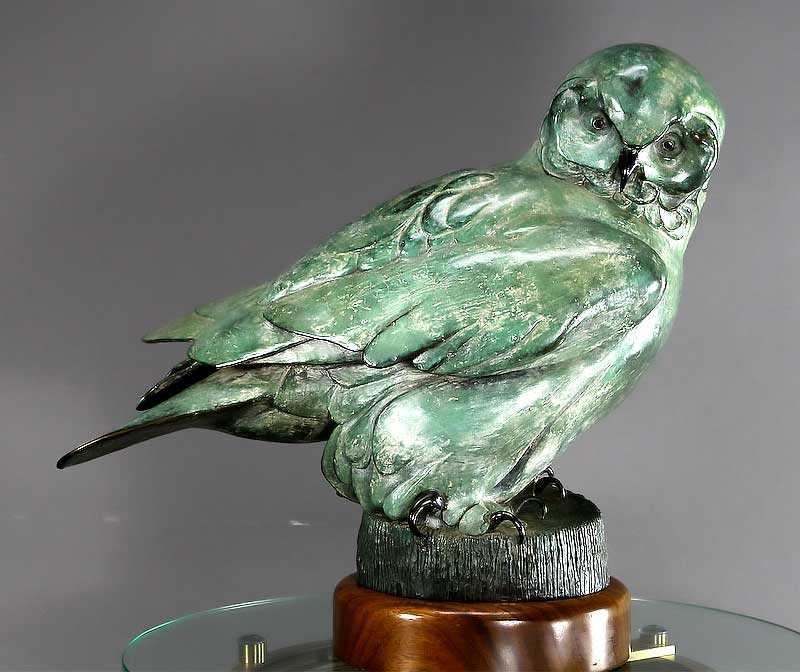
La première pièce, marquée E.A. pour épreuve d’artiste, m’a permis de créer un moule à partir duquel plusieurs exemplaires ont vu le jour. Certains ont été retravaillés en hauts-reliefs, mais l’œuvre originale restait unique. Je l’ai baptisée Ookpik, en hommage à son nom inuit. Contrairement à son plumage naturellement blanc, j’ai choisi pour cette sculpture une patine verte, évoquant la stéatite, ou pierre à savon, si chère à l’art inuit.
Cette couleur inscrivait le Harfang dans une tradition culturelle et symbolique, le transformant en mon propre Horus, un dieu nordique aux griffes acérées, veillant sur son monde avec vigilance et sérénité.
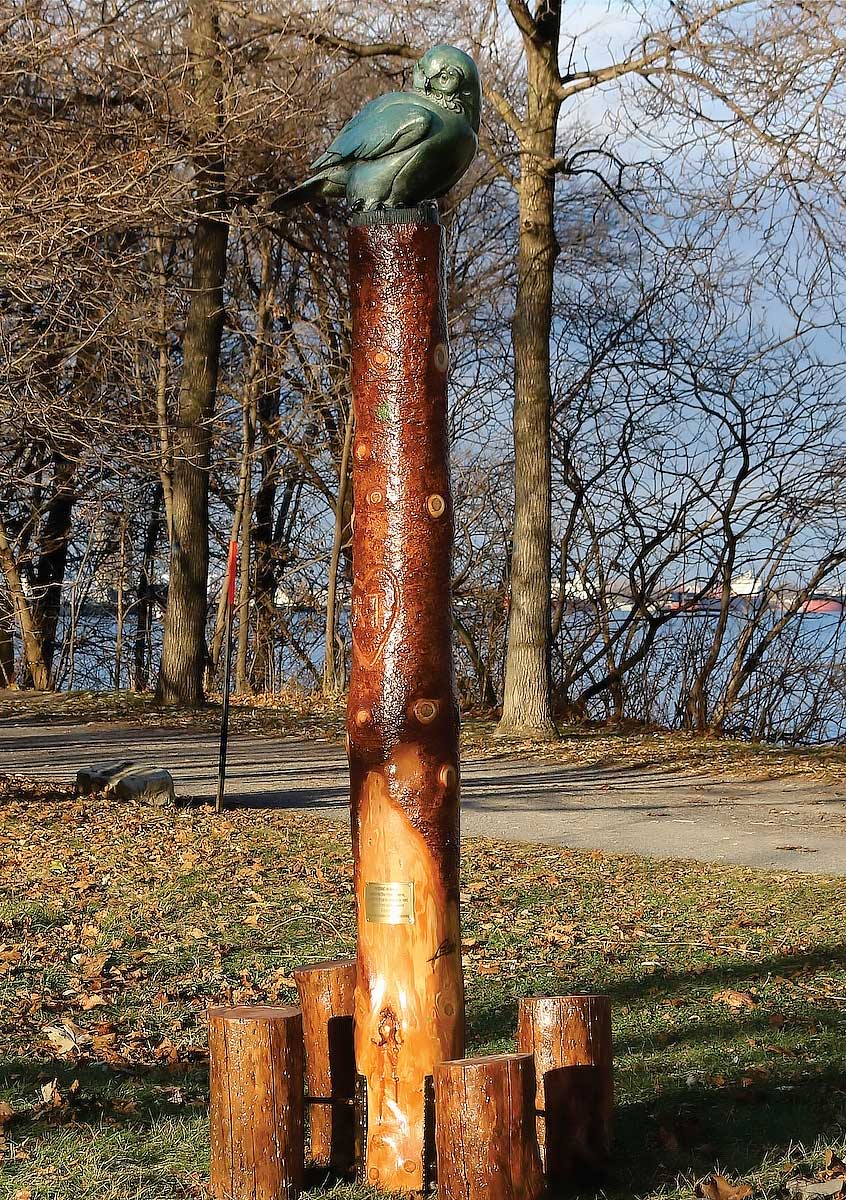
Mais le temps, comme toujours, a poursuivi son cours, et l’histoire de ce Harfang ne s’est pas arrêtée là. En 2022, un ami très cher, Réjean, fermier traditionnel de Saint-Placide, m’a offert un billot de sapin de presque six pieds de long. Ce morceau de bois portait en lui une histoire profondément humaine : il provenait d’un arbre que son épouse Thérèse avait planté cinquante ans auparavant.
À l’époque, ils étaient jeunes fiancés. Lors d’une promenade sur la terre familiale, Thérèse avait ramassé une petite pousse de sapin qu’elle avait tenu contre son torse sur le chemin du retour. Une fois chez eux, elle avait planté cette pousse devant leur maison, où l’arbre avait grandi, devenant un témoin silencieux de leur vie commune. Mais la nature est parfois cruelle. Quelques décennies plus tard, un grand vent avait brisé la cime de ce sapin solitaire.
En me remettant le tronc, Réjean espérait que je pourrais lui donner une nouvelle vie, un prolongement artistique qui prolongerait son histoire.
Dans mon atelier, je contemplais ce billot marqué par les années, à côté de ma sculpture en bronze du Harfang des neiges. Ces deux éléments semblaient attendre un dialogue, une fusion qui n’était pas encore écrite.
Depuis plus de cinquante ans, une part importante de mon travail artistique s’attache à questionner la relation entre l’humain et son environnement, à explorer les fragilités d’un monde que nous transformons souvent sans le comprendre.
J’ai décidé de faire du tronc un socle élevé pour le Harfang, mais pas un simple piédestal. Ce socle devait raconter une histoire, porter un message. J’ai ajouté au tronc quatre petits billots fixés avec des tiges d’acier forgées par mes soins. Ces éléments supplémentaires représentaient à la fois un équilibre structurel et les quatre points cardinaux, comme une boussole pour notre monde.
Sur ces billots, j’ai pyrogravé des plaques symboliques :
- Une abeille butinant une fleur, fragile écho de l’interdépendance des écosystèmes.
- Un chevreuil fier et un poisson frétillant, rappel des équilibres fauniques brisés par l’avidité humaine.
- Un oiseau en vol, symbole poignant de la disparition rapide des populations aviaires.
- Un arbre majestueux et une gerbe de blé, témoins des ravages de la déforestation et des excès de l’agriculture chimique.
Le tronc lui-même, partiellement dénudé, symbolise la nature mise à nu, fragilisée. Au centre, j’ai gravé un cœur contenant les initiales R et T, en hommage à Réjean et Thérèse, dont la simplicité et l’humanité m’inspirent profondément.
Ainsi, du haut de son promontoire de bois, le Harfang de bronze s’élève comme un gardien silencieux. Ses yeux perçants semblent poser une question simple mais essentielle
Que faisons-nous de son monde, de notre monde ?
L’art, pour moi, est une conversation. Entre le passé et le présent. Entre l’humain et le vivant. Entre la mémoire et l’avenir. Cette œuvre, comme toutes les autres, pose une question, laisse une empreinte, invite à réfléchir. Que restera-t-il, dans cinquante ans, de ces abeilles, de ces oiseaux, de ces arbres ? Je n’ai pas la réponse, mais je sais que, l’Art, le premier Art de tous est l’art de devenir … Humain. Ce qui ne peut se faire sans persister à poser les bonnes questions.

The Snowy Owl, the Log, and the Horizon of a World in Transformation
It was 1962, a year etched in my memory as a defining moment. I was 12 years old, and that year, a passionate teacher from France, Robert Féger, introduced us to the wonders of ancient civilizations. An amateur archaeologist in his spare time, he had a contagious fervor for conveying the importance of the traces humanity has left through the ages. Among these civilizations, ancient Egypt stood out for the grandeur and depth of its works. These creations, born from the depths of time, cast their majestic shadow over our contemporary era, like an echo from another world.
I still vividly remember, with almost tactile precision, a stone sculpture depicting Horus, the falcon god, stylized and timeless. The elegance of its lines, its powerful symbolism, the precision of its details: everything about this work had profoundly moved me. For the young boy I was then, it was a revelation.
A few years earlier, in February 1959, I had celebrated my ninth birthday, a milestone marked by a promise I made to myself. In the midst of a summer illuminated by blazing sunlight, I made an almost instinctive inner decision: I would become an artist. I already knew I wanted to build a life opposite to the miserable childhood I was living at the time. By age 12, this resolve translated into my first creations, as I carved simple pieces of soft wood with a pocketknife, inspired by the images in archaeology books I leafed through with fascination.
Nearly thirty years later, this impulse had transformed into a passion for bronze sculpture. Avian art became a recurring theme in my work, a universe that, like Egyptian art, carried a strong and timeless symbolic charge.
In this quest, I found my own “Horus,” a personal figure that echoed the one that had so deeply marked me as a child. At the time, my agent, Normand Prescott, had borrowed a stuffed snowy owl for me from the Université du Québec à Trois-Rivières. For a month, this majestic bird reigned in my studio, motionless and silent, like a muse from the cold. I transformed it into a life-sized sculpture, shaped in wax and cast in bronze using the lost-wax process at the Artcast foundry in Georgetown, near Toronto, in the absence of an equivalent facility in Quebec.
The first piece, marked E.A. for artist’s proof, allowed me to create a mold from which several copies were made. Some were reworked into high reliefs, but the original remained unique. I named it Ookpik, in homage to its Inuit name. Unlike its naturally white plumage, I chose a green patina for this sculpture, evoking soapstone, so dear to Inuit art.
This color rooted the snowy owl in a cultural and symbolic tradition, transforming it into my own Horus, a Nordic god with sharp claws, watching over its world with vigilance and serenity.
But time, as always, continued its course, and the story of this snowy owl did not end there. In 2022, a dear friend, Réjean, a traditional farmer from Saint-Placide, gifted me a nearly six-foot-long fir log. This piece of wood carried a deeply human story: it came from a tree that his wife, Thérèse, had planted fifty years earlier.
Back then, they were young fiancés. During a walk on the family land, Thérèse had picked up a small fir sprout and held it against her chest on the way home. Once there, she planted it in front of their house, where the tree grew, becoming a silent witness to their shared life. But nature can be cruel at times. Decades later, a strong wind broke the top of this solitary fir.
By giving me the log, Réjean hoped I could give it new life, an artistic extension that would continue its story.
In my studio, I contemplated this weather-worn log next to my bronze snowy owl sculpture. These two elements seemed to await a dialogue, a fusion yet to be written.
For over fifty years, a significant part of my artistic work has focused on questioning the relationship between humanity and its environment, exploring the fragilities of a world we often transform without understanding.
I decided to make the log a raised base for the snowy owl, but not a mere pedestal. This base had to tell a story, carry a message. I added four smaller logs, fixed with steel rods I forged myself. These additional elements represented both structural balance and the four cardinal points, like a compass for our world.
On these logs, I pyrographed symbolic plaques:
- A bee pollinating a flower, a fragile echo of the interdependence of ecosystems.
- A proud deer and a wriggling fish, reminders of the faunal balances broken by human greed.
- A bird in flight, a poignant symbol of the rapid disappearance of avian populations.
- A majestic tree and a sheaf of wheat, witnesses to the ravages of deforestation and the excesses of chemical agriculture.
The log itself, partially stripped, symbolizes nature laid bare, made vulnerable. At its center, I carved a heart containing the initials R and T, in homage to Réjean and Thérèse, whose simplicity and humanity deeply inspire me.
Thus, atop its wooden promontory, the bronze snowy owl rises like a silent guardian. Its piercing eyes seem to ask a simple yet essential question:
What are we doing with its world, with our world?
For me, art is a conversation. Between the past and the present. Between humanity and the living. Between memory and the future. This work, like all others, poses a question, leaves a mark, invites reflection. What will remain, in fifty years, of these bees, these birds, these trees? I don’t have the answer, but I know that Art, the first Art of all, is the art of becoming… Human. And that cannot happen without persistently asking the right questions.