English version follows bellow
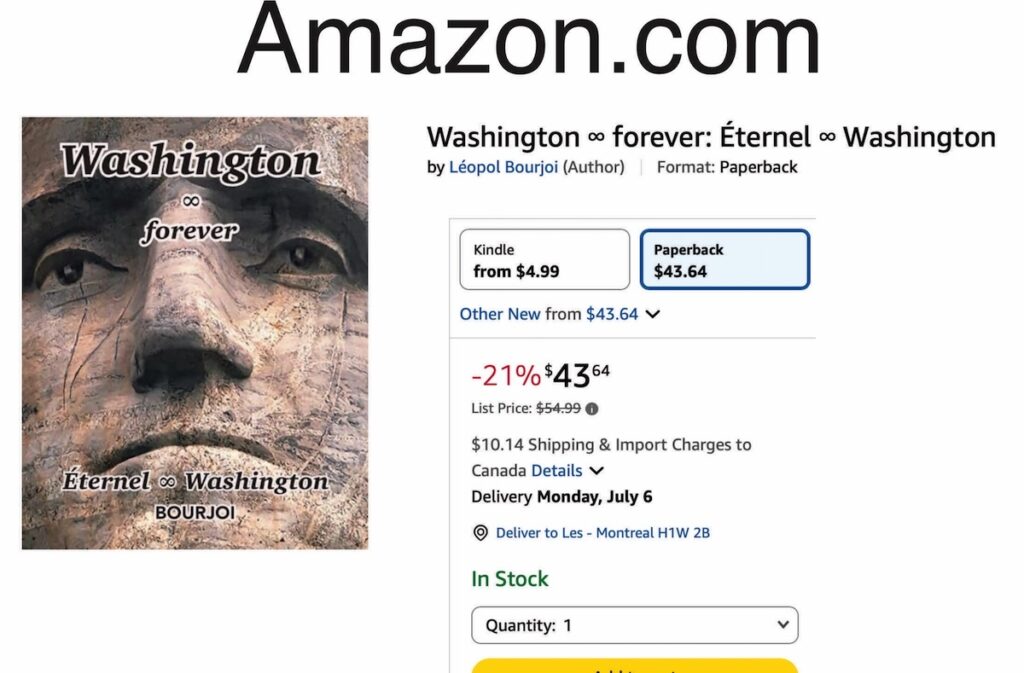
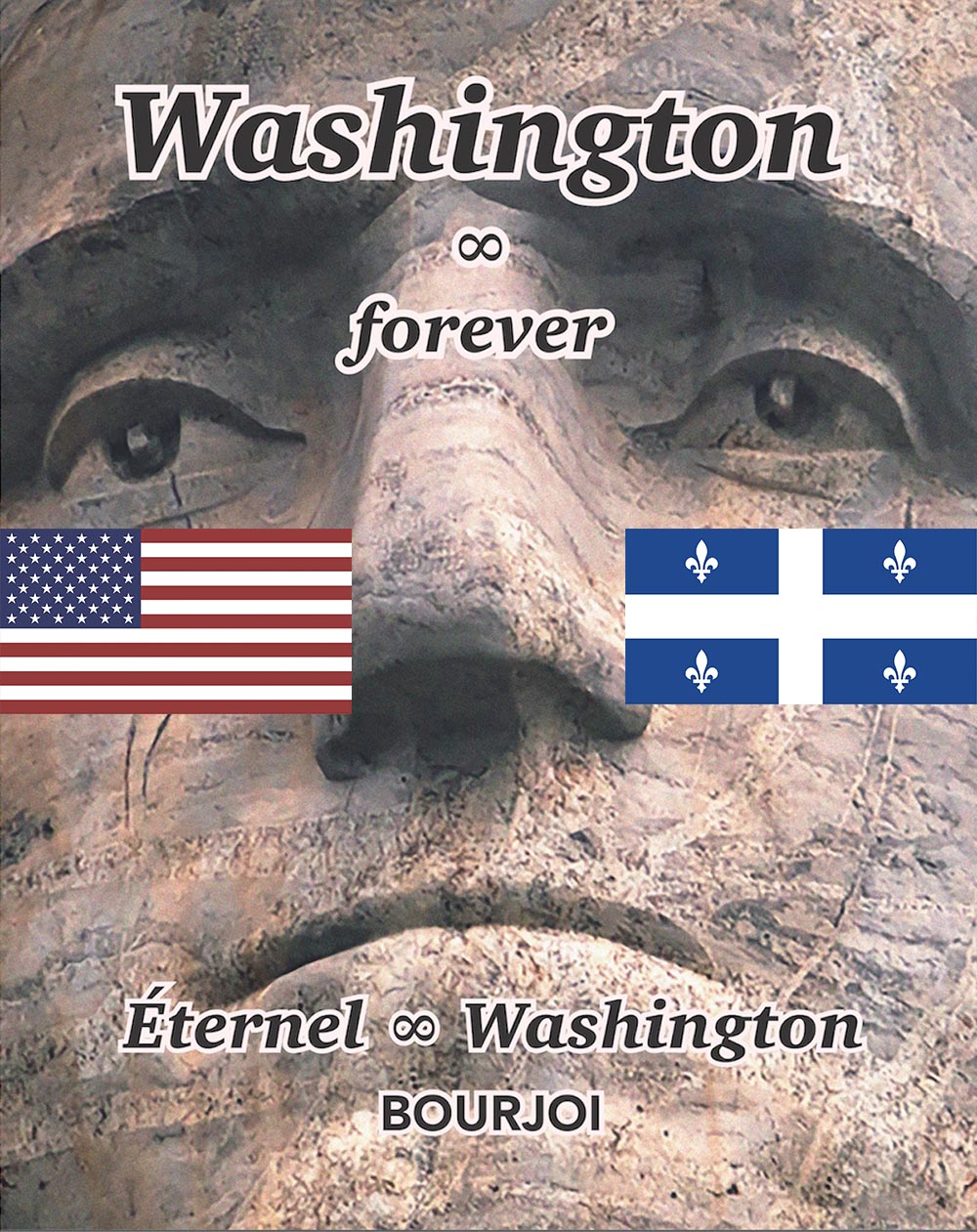
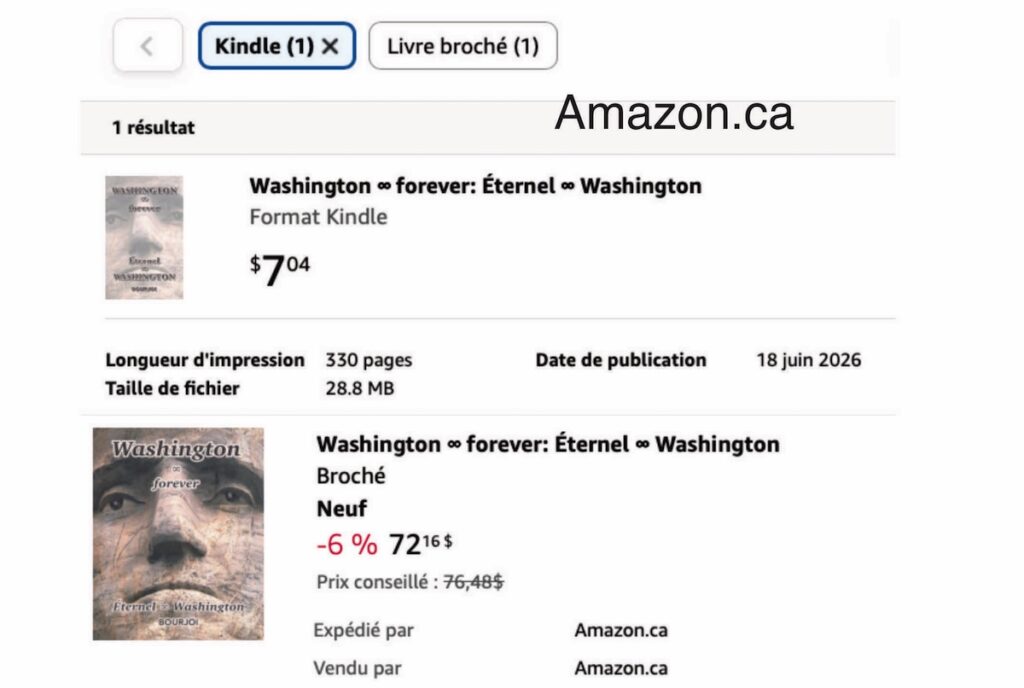
Washington ∞ forever / Éternel ∞ Washington
Alors que la Révolution américaine de 1776, dans un fracas d’éclairs et de canons, permit à tout un peuple de se dresser, souverain, mature, de sceller courageusement sa capacité d’être une nation libre et digne, la Révolution tranquille au Québec, elle, ne fut qu’une révolution étatique, froide, administrative, imposé d’en haut, qui n’a que changé les meubles de place et repeint les murs qui, ne venant pas des profondeurs de notre âme, ne put, par sa faiblesse même, confirmer notre capacité à être souverains ensemble.
Et par là, nous priva, pour un temps seulement, je n’en doute pas, de notre maturité collective, de cette flamme intérieure qui seule permet d’accéder, par notre vitale et unique volonté à la véritable Souveraineté.
C’est pour cela, que j’ai écrit et publié Washington ∞ forever / Éternel ∞ Washington.
Pour témoigner, devant l’Histoire et devant le destin, que la souveraineté véritable ne naît ni des urnes, ni des événements favorables, ni des décrets d’État, mais jaillit de soi, et du « tous ensemble » malgré tout ce qui s’y oppose, malgré les vents contraires, malgré les chaînes invisibles, malgré les peurs terrifiantes qui hurlent dans la nuit.
Nous ne devons pas hésiter pour cela de poursuivre le dialogue ardent avec cette terre d’Amérique voisine qui accueillit, il n’y a pas si longtemps, près de neuf cent mille Québécois, exilés de leur propre rêve.
Je n’ai ni le génie fulgurant de Victor Hugo dans Les Misérables, ni la lucidité glacée de George Orwell dans 1984, ni la fureur terrestre d’Émile Zola dans Germinal, ni la sagesse forestière de Henry David Thoreau dans Walden.
Pourtant, la peine qui m’étreint devant ce qui est délibérément infligé aux peuples et à l’humanité en ce XXIᵉ siècle est la même : une blessure vive, un profond désappointement, un malaise sans nom.
Ce qui me conduit à affirmer, qu’Il est indéniable que l’Art, le premier Art de tous, est l’art suprême de devenir souverainement Humain.
Né en 1950 à Montréal, doté à la main gauche de seulement trois doigts fermement tendus vers le destin, j’ai frôlé la mort neuf fois avant mes six ans.
Deux frères et sœurs m’avaient précédé dans l’ombre : l’un emporté par la méningite, l’autre asphyxié par le monoxyde de carbone. Ces tragédies, qui firent la une des journaux, gravèrent une plaie éternelle dans le cœur de ma mère.
Mon père, homme de fer et de volonté farouche, bâtissait de ses mains une forteresse familiale tout en défiant un destin qu’il sentait hostile. Entre un foyer chaotique et les longs séjours au Royal Victoria, je découvris la lecture et la solitude créatrice. Les bandes dessinées, les livres, la lueur tremblante de l’écran et la grande voix souveraine de la nature devinrent mes refuges sacrés, mes cathédrales intimes.
Après le naufrage familial de 1960 lorsque nous avons été expulsés de notre maison, suivi de l’internement de notre père, je dus creuser, de mes propres mains, un chemin vers l’avenir qui devait être radieux.
Ouvrier par choix, autodidacte insatiable, je pratiquai mille métiers : du chantier boueux à l’usine grondante, de la menuiserie odorante à la soudure incandescente. Puis ayant cumulé des dizaines d’exposions de mes œuvres, je me suis déplacé des chantiers aux bancs d’université. Chaque geste, chaque idée devint matière à transmuer.
Le bronze d’art, rencontré en 1979, transforma mon existence en alchimie vivante : cire perdue, feu purificateur, patine alchimique devinrent mon langage le plus intime. Je fondai même un institut des techniques de fonderie du bronze avant de le fermer lorsque l’État contribua à faire naître la Fonderie d’Art d’Inverness. Parallèlement, je caressais la peinture, le graphisme, puis la lumière froide et infinie de l’ordinateur. Marié, père de deux filles, j’ai traversé divorces, deuils et renaissances multiples. Chaque épreuve polissait davantage ma conviction profonde : L’art n’est pas seulement la création d’œuvres ; il est l’art suprême de devenir pleinement Humain. L’ADN-Soi atavique, permanent, et l’Ego-Moi culturel, transitoire, doivent apprendre à dialoguer dans la paix.
Alors la vie bien habitée devient l’œuvre véritable, la plus haute, la plus noble. C’est au cœur incandescent de cette quête qu’est née la série Aspire. En 1998, après un pèlerinage bouleversant à Mount Vernon, la ferme de George Washington, je conçus Aspire W.
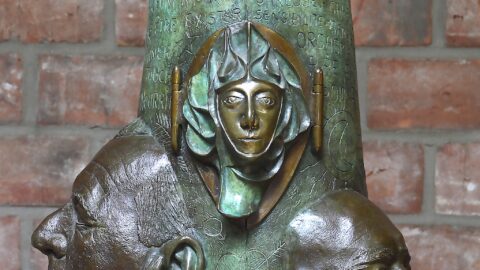
Cette œuvre monumentale ne représente pas simplement un portrait de George Washington : elle l’incarne, elle le respire, elle le fait revivre. Torse puissant donnant forme à l’aigle américain, poitrine ruisselante d’or 24 carats, cœur creusé en lac où flotte une colombe, suivant la forme éternelle de la girouette de Mount Vernon. Ses ailes portent les idéaux français — Liberté, Égalité, Fraternité —et américains du We the People.
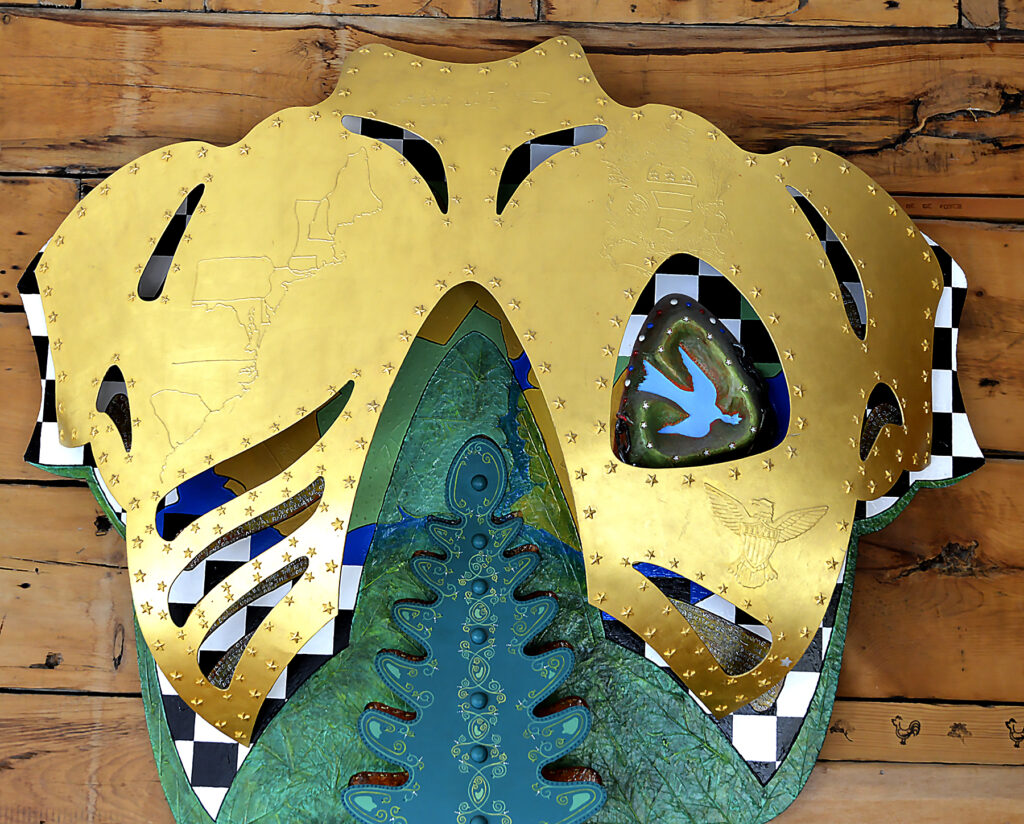
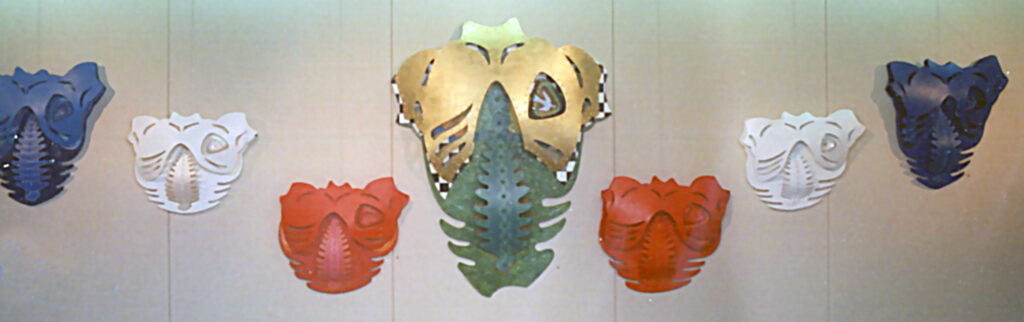
Les maximes de Washington y sont gravées comme des invocations se traduisant en service désintéressé, confiance en la Providence, amour des arts et des sciences, respect sacré de la diversité des esprits.
Washington, fermier-président, refusa la couronne et libéra ses esclaves par testament. À l’image de ses compagnons, il incarnait cette maturité souveraine qui sut se retrouver en son propre exemple : ancré dans la terre nourricière, ouvert au ciel immense, maître de soi avant d’être maître des autres.
Sa révolution ne fut pas seulement politique ; elle fut surtout profondément humaine. Face au danger, il avait saisi l’enjeu vital : « If we don’t hang together, we will be hung separately. » « Si nous ne restons pas unis, nous serons pendus séparément. » Par contraste, la Révolution tranquille, en ne changeant que notre manière de vivre ensemble, nous priva — je n’en doute point — seulement pour un temps de notre capacité à « être » ensemble, de notre maturité collective et de notre capacité à être souverains. Capacité que nous retrouverons dès que nous croirons suffisamment en nous par nous, pour nous, pour l’embrasser avec courage et dignité.
Aspire W devient ainsi un pont vivant, vibrant, entre hier et demain, entre la main rugueuse de l’ouvrier et l’idéal lumineux, entre le Québec et les États-Unis. Elle proclame que la souveraineté réelle naît au plus près du sol, dans l’art patient de devenir humain malgré tout. Afin que notre histoire et notre culture s’affirment enfin, sans tremblement ni hésitation.
Aujourd’hui, face à la concentration des pouvoirs, aux angoisses qui montent comme des marées noires et aux cycles d’effondrement qui ne cessent de se succéder, ce message brûle d’urgence. La sortie ne viendra que du local, par une reconstruction patiente de soi et du «tous ensemble» à échelle humaine.
Ce livre est mon témoignage : d’une vie labourée d’épreuves à une œuvre qui aspire à être plus grande que soi. Puissiez-vous y trouver écho, espérance et salutaire conviction. Puissent ces pages allumer en chaque âme la flamme sacrée du désir de reprendre en main sa souveraineté intérieure, afin que, ensemble, quelles que soient les menaçantes circonstances, nous osions enfin être souverainement nous-mêmes. Car sans cette souveraineté intime et surtout convaincue et courageuse, aucune révolution ne permet d’accéder à la véritable Souveraineté.
Bourjoi, juillet 2026
Livre bilingue publié sur Amazon format E-book et imprimé.https://www.amazon.fr/dp/B0H5Z1J63R

English version
Washington ∞ forever
While the American Revolution of 1776, in a thunder of lightning and cannon fire, allowed an entire people to rise up, sovereign and mature, courageously sealing its capacity to become a free and worthy nation, the Quiet Revolution in Quebec was merely a state revolution—cold, administrative, imposed from above. It merely rearranged the furniture and repainted the walls.
Since it did not spring from the depths of our soul, its very weakness prevented it from confirming our collective capacity to be sovereign together. And in doing so, it deprived us—for a time only, I have no doubt—of our collective maturity, of that inner flame which alone allows us to access, through our vital will to access it, true Sovereignty.
That is why I wrote and published Washington ∞ forever / Éternel ∞ Washington.
To bear witness, before History and before destiny, that true sovereignty is not born from ballots, nor from favorable events, nor from state decrees, but surges forth from within oneself, and from the “all together” despite everything that opposes it—despite contrary winds, despite invisible chains, despite the terrifying fears that howl in the night.
For this reason, we must not hesitate to pursue an ardent dialogue with this neighboring land of America, which not so long ago welcomed nearly nine hundred thousand Quebeckers, exiled from their own dream.
I do not possess the blazing genius of Victor Hugo in Les Misérables, nor the icy lucidity of George Orwell in 1984, nor the earthly fury of Émile Zola in Germinal, nor the forest wisdom of Henry David Thoreau in Walden.
Yet the grief that grips me before what is deliberately inflicted upon peoples and the world in this 21st century is the same: a raw wound, a profound disappointment, a nameless malaise.
This leads me to affirm that Art, the very first Art of all, is the supreme art of becoming fully Human.
Born in 1950 in Montreal, with only three fingers on my left hand firmly outstretched toward destiny, I brushed against death nine times before the age of six. Two brothers and sisters had preceded me into the shadows: one carried off by meningitis, the other asphyxiated by carbon monoxide. These tragedies, which made the front pages of the newspapers, carved an eternal wound into my mother’s heart.
My father, a man of iron and fierce will, built with his own hands a family fortress while defying a destiny he sensed was hostile. Between a chaotic home and long stays at the Royal Victoria Hospital, I discovered reading and creative solitude. Comic books, real books, the flickering glow of the screen, and the great sovereign voice of nature became my sacred refuges, my intimate cathedrals.
After the family shipwreck of 1960, when we were expelled from our home, followed by our father’s institutionalization, I had to dig, with my own hands, a path toward a future that was meant to be radiant.
A worker by choice, an insatiable autodidact, I practiced a thousand trades: from muddy construction sites to roaring factories, from fragrant carpentry to incandescent welding. Then, having accumulated dozens of exhibitions of my works, I moved from the worksites to the university benches. Every gesture, every idea became material to be transmuted.
Art bronze, encountered in 1979, transformed my existence into living alchemy: lost-wax casting, purifying fire, alchemical patina became my most intimate language. I even founded an institute for bronze foundry techniques before closing it when the State helped bring about the Fonderie d’Art d’Inverness.
At the same time, I embraced painting, graphic design, and then the cold and infinite light of the computer. Married, father of two daughters, I went through divorces, bereavements, and multiple rebirths. Each ordeal further polished my deep conviction: Art is not merely the creation of works; it is the supreme art of becoming fully Human.
The atavistic DNA-Self, permanent, and the cultural Ego-Self, transitory, must learn to dialogue in peace. Then a well-lived life becomes the true work, the highest and most noble. It is at the incandescent heart of this quest that the Aspireseries was born.
In 1998, after a deeply moving pilgrimage to Mount Vernon, I conceived Aspire W. This monumental work does not merely represent a portrait of George Washington: it embodies him, it breathes him, it brings him back to life. A powerful torso that gives form to the American eagle, a chest streaming with 24-carat gold, a heart hollowed out into a lake where a dove floats, following the eternal shape of the Mount Vernon weather vane. Its wings carry the French ideals—Liberty, Equality, Fraternity—and the American ideals of We the People.
Washington’s maxims are engraved there like invocations, translating into disinterested service, trust in Providence, love of the arts and sciences, and sacred respect for the diversity of minds.
Washington, farmer-president, refused the crown and freed his slaves by will. Like his companions, he embodied that sovereign maturity which knew how to find itself in its own example: rooted in the nurturing earth, open to the vast sky, master of himself before being master of others.
His revolution was not merely political; it was profoundly human. Facing danger, he had grasped the vital stake: “If we don’t hang together, we will be hung separately.” By contrast, the Quiet Revolution, by changing only our way of living together, deprived us—I have no doubt—of our capacity to “be” together, of our collective maturity and our capacity to be sovereign. A capacity we will regain as soon as we believe sufficiently in ourselves, by ourselves, for ourselves, to embrace it with courage and dignity.
Aspire W thus becomes a living, vibrant bridge between yesterday and tomorrow, between the rough hand of the worker and the luminous ideal, between Quebec and the United States. It proclaims that real sovereignty is born closest to the soil, in the patient art of becoming human despite everything. So that our history and our culture may finally assert themselves, without trembling or hesitation.
Today, in the face of the concentration of powers, the anxieties rising like black tides, and the cycles of collapse that continue to follow one another, this message burns with urgency. The way out will come only from the local, through a patient reconstruction of the self and of the “all together” on a human scale.
This book is my testimony: from a life plowed by trials to a work that aspires to something greater than itself. May you find in it an echo, hope, and a salutary conviction. May these pages ignite in every soul the sacred flame of the desire to reclaim one’s inner sovereignty, so that, together, whatever the threatening circumstances, we may finally dare to be sovereignly ourselves. For without this intimate sovereignty, no revolution can lead to true Sovereignty.
Bourjoi, July 2026
Available on Amazon.com and Amazon.cahttps://www.amazon.fr/dp/B0H5Z1J63R