Septum
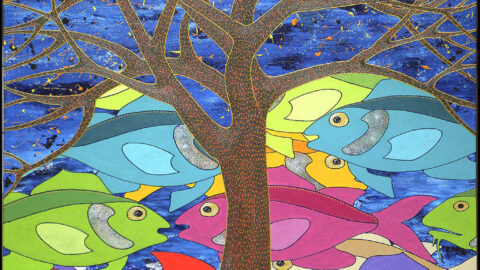
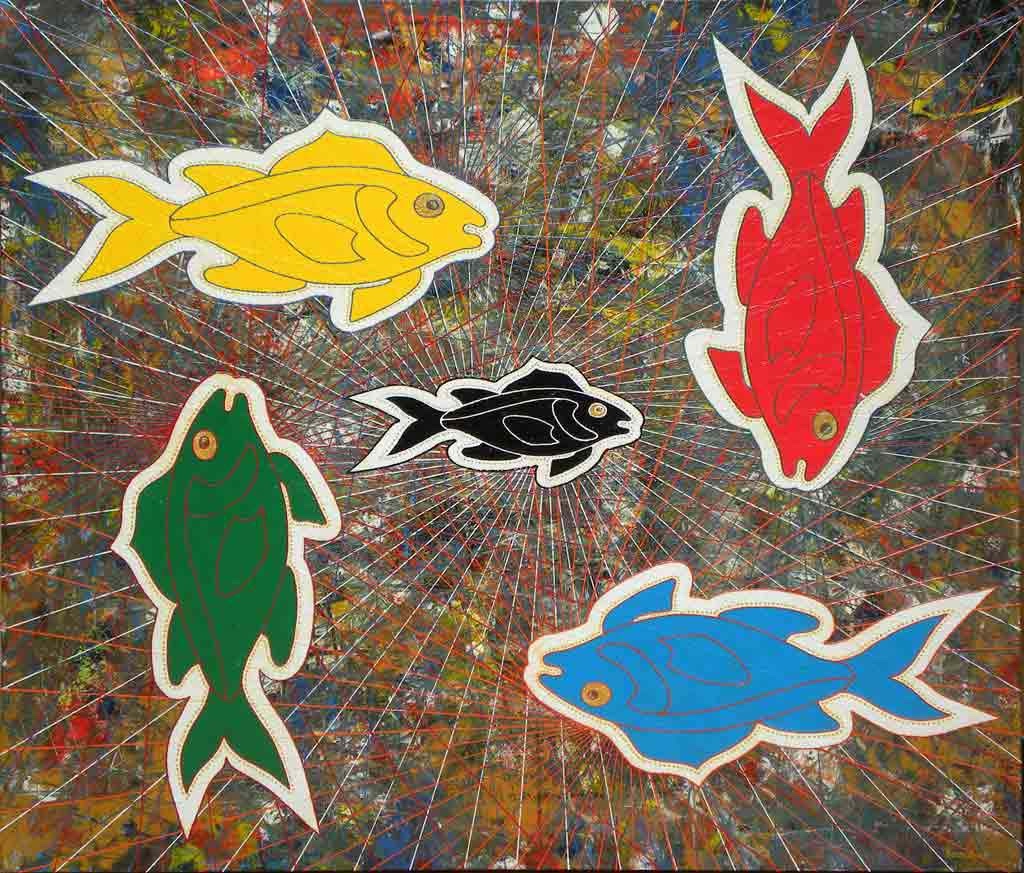
Peinture acrylique sur caisson de bois, 107 x 122 cm
English version follows below
Un septum en latin peut être soit une haie, une cloison ou une paroi.
D’où le titre de cette œuvre. Le septum comme pellicule, comme s’il était le moi-peau, l’organe le plus étendu de l’organisme humain, la mince barrière entre le dedans et le dehors, sous lequel se devinent les entrailles et à la surface duquel les rencontres avec la matérialité du réel. Le sens et la matérialité formelle que traduit le langage plastique.
Lorsque Magritte a peint le tableau intitulé, Ceci n’est pas une pipe, il affirmait, ce qui nous semble évident maintenant, que l’illustration d’une pipe n’était pas l’équivalent de la pipe réelle.
Au cours des années soixante, le tableau, sous l’impulsion de Clement Greenberg, critique d’art américain, est devenu planéité et matière à peindre en soi. Sous les coups de boutoir du non-figuratif, la matière elle-même et la surface du tableau sont devenues objets mêmes de l’art.
Même autodidacte, au début de la vingtaine, je cherchais parfois cette manière de peindre que n’auraient jamais approuvée les maîtres du passé.
Beaucoup plus jeune, j’avais parfois la sensation de percevoir le mouvement des circonvolutions cérébrales sous l’os du crâne. Parfois, faire de l’art, peindre ou sculpter revient à retrouver les sensations sous-jacentes. Il y avait aussi que lorsque j’imaginais une sculpture, le noyau de l’œuvre était et est toujours de nature proprioceptive. Il arrive que la sculpture soit mouvements et attitudes du corps de l’artiste, alors que lorsque je peins tout ce qui compose un tableau, le langage plastique dans toutes ses manifestations de nature formelle et conceptuelle de par leurs similitudes avec la planéité de l’écrit plutôt que littéraire, est surtout de nature narrative.
La surface peinte et texturée de Septum est comme les tatouages et les scarifications, les rides et cicatrices d’un moi-peau, une mince peau flexible recouvrant sans y adhérer, l’animation sous-jacente des constructions psychiques et des mécanismes fondateurs du moi.
Au centre de la surface de l’œuvre couverte d’un chaos texturé rayonne un objet incolore noir et blanc relié à égalité au bleu, jaune, rouge du réel tout en irradiant vers le rouge, vert, bleu de l’imaginaire humain qui dès la rétine dérive le long des fibres vers un monde onirique.

A septum in Latin can refer to a hedge, a partition, or a wall. Hence the title of this work. The septum as a membrane, as if it were the « skin-ego, » the most extensive organ of the human body, the thin barrier between the inside and the outside, beneath which the entrails are glimpsed and on whose surface encounters with the materiality of reality occur. The meaning and formal materiality conveyed by the plastic language.
When Magritte painted the work titled This Is Not a Pipe, he was asserting—what now seems obvious—that the illustration of a pipe was not equivalent to the actual pipe.
In the 1960s, under the influence of American art critic Clement Greenberg, the painting became flatness and paint matter in itself. Under the onslaught of non-figurative art, the material itself and the surface of the painting became the very objects of art.
Even as a self-taught artist in my early twenties, I sometimes sought this way of painting that the masters of the past would never have approved of.
Much younger, I sometimes had the sensation of perceiving the movement of cerebral convolutions beneath the bone of the skull. Sometimes, making art, painting, or sculpting means rediscovering these underlying sensations.
There was also the fact that when I imagined a sculpture, the core of the work was—and still is—proprioceptive in nature. It happens that a sculpture is the movements and attitudes of the artist’s body, whereas when I paint, everything that composes a painting—the plastic language in all its formal and conceptual manifestations, due to its similarities with the flatness of writing rather than literature—is primarily narrative in nature.
The painted and textured surface of Septum is like tattoos and scarifications, the wrinkles and scars of a skin-ego, a thin, flexible skin covering—without adhering to—the underlying animation of psychic constructions and the foundational mechanisms of the self.
At the center of the work’s surface, covered with textured chaos, radiates a colorless black-and-white object, equally connected to the blue, yellow, and red of reality, while radiating toward the red, green, and blue of the human imagination, which, from the retina, drifts along the fibers toward a dreamlike world.